
I'm Not an Efficient Writer
How many times do I need to learn this lesson? Too many.

Pssst. I’m teaching a new workshop Beyond Character Tropes: Using the Modern Love Languages Framework to Craft Dynamic Relationships for my Maryland Romance Writers group this Saturday, June 27th. It’s hybrid and you don’t have to be a member (or in Maryland) to join. Details here.
I’ve giving up trying to be an efficient writer.
Yes, I fall off the wagon (often), but I eventually learn (again) that fiction writing isn’t supposed to be efficient. I’m not a machine or a computer churning out random characters, settings, and plot points.
In May, I set a goal to fast draft my sapphic heist romance by the end of the summer. Why would a “slow” writer set such an ambitious goal? Because the traditional publishing world is—waves hands—in even more turmoil than before.
My agent gave me positive feedback on the first 21k of this novel, but she wanted more of the heist planning elements. Because of my previous books’ “soft sales” (publishing’s nice way of saying low sales), my agent wanted to present the best representation of this novel as we could. She was pleased with the romance and Viet pop elements but wanted more heist stuff.
I agreed because I wanted to give this book the best chance of selling. I figured if I was adding another 10k words or so, why not try to finish the entire draft by the end of summer? I can’t control if a publisher will want this book, but I can control what and how I write.
How it started:
I then posted my wild goal on Substack notes. My friend Lyssa Kay Adams was also attempting to finish her current draft by the end of summer and did I want some accountability. YES! We quickly set up some virtual body doubling time to write.
At first I struggled to write. June has been a roller coaster of insomnia, fatigue, and pain. The unpredictability of my chronic illness made it hard for me to find flow in my creative work many days.
After one very productive session, Lyssa told me about Jessica Brody’s new book Page One to Done. Though Lyssa and I approach our writing differently, I was willing to give the book a try. I haven’t finished reading it yet, but Brody has a lot of actionable tips.
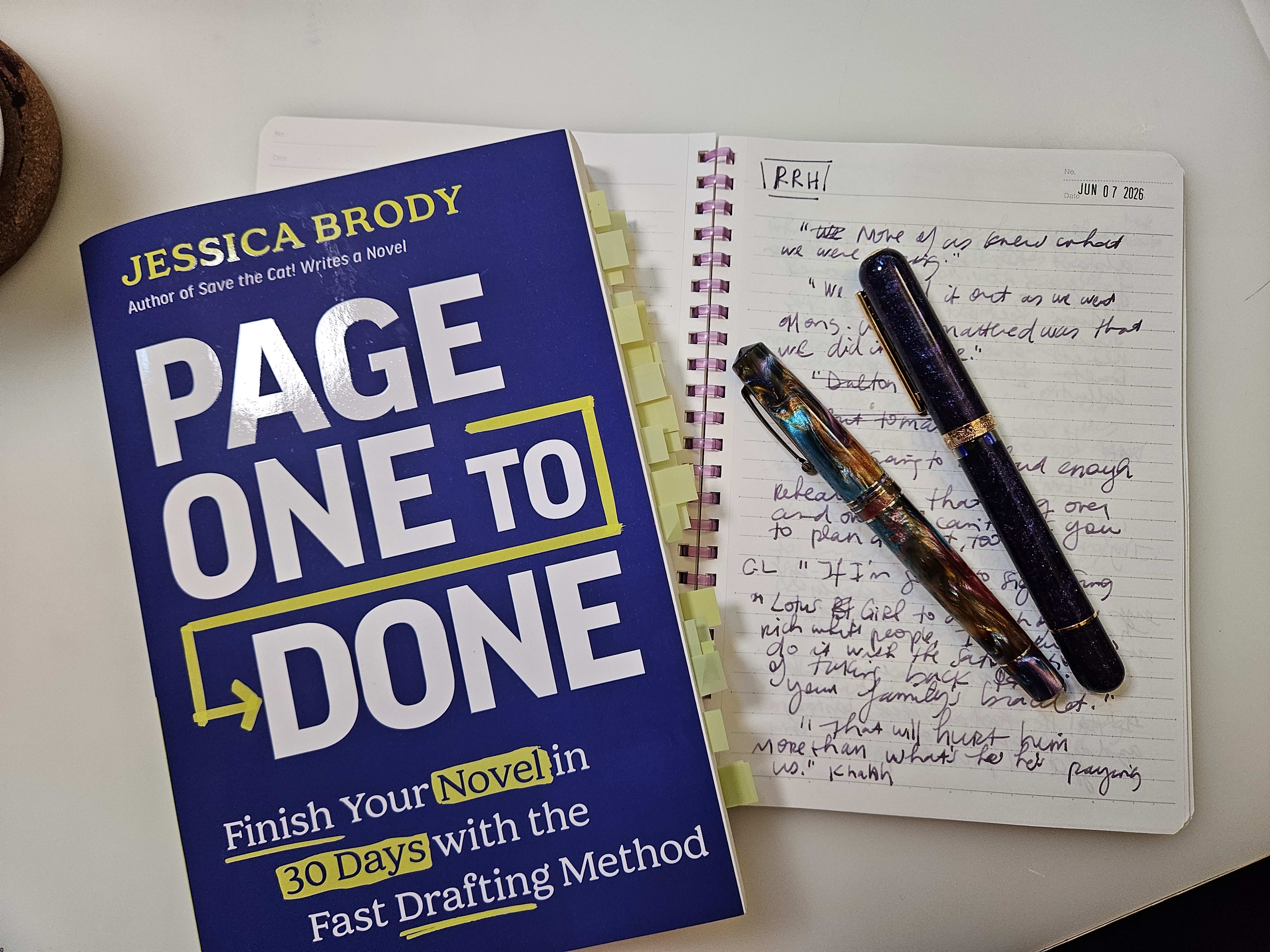
The only one that didn’t resonate with me was the writing routine. I’ve never had luck with making or sticking with a routine because I don’t know if my body and brain will cooperate each day. It’s a surprise until I sit at my desk.

The most helpful advice from Page to Done was to get the words down. No editing. No fixing typos. Things that make me twitch because sometimes the words come out faster than my fingers can type. While it’s not new to me advice, hearing how Lyssa was able to increase her word count each session motivated me to try it.
How I struggled:
Turning off that inner editor was hard. Really fucking hard.
As a heritage Vietnamese speaker who learned English as a second language, I made sure to be a great speller and know all the rules of grammar. I wasn’t giving anyone an excuse to disparage my work. Now I speak and write English miles better than Vietnamese, but that “safe” feeling of perfect grammar and spelling still exists.
I tried really hard to ignore all the red-lined words in NovelPad, my writing app. (I never turn on the grammar checker.) But they kept poking at my eyeballs. Because I was trapped in this cycle of fixing my typos, I could never find my flow during my sessions.
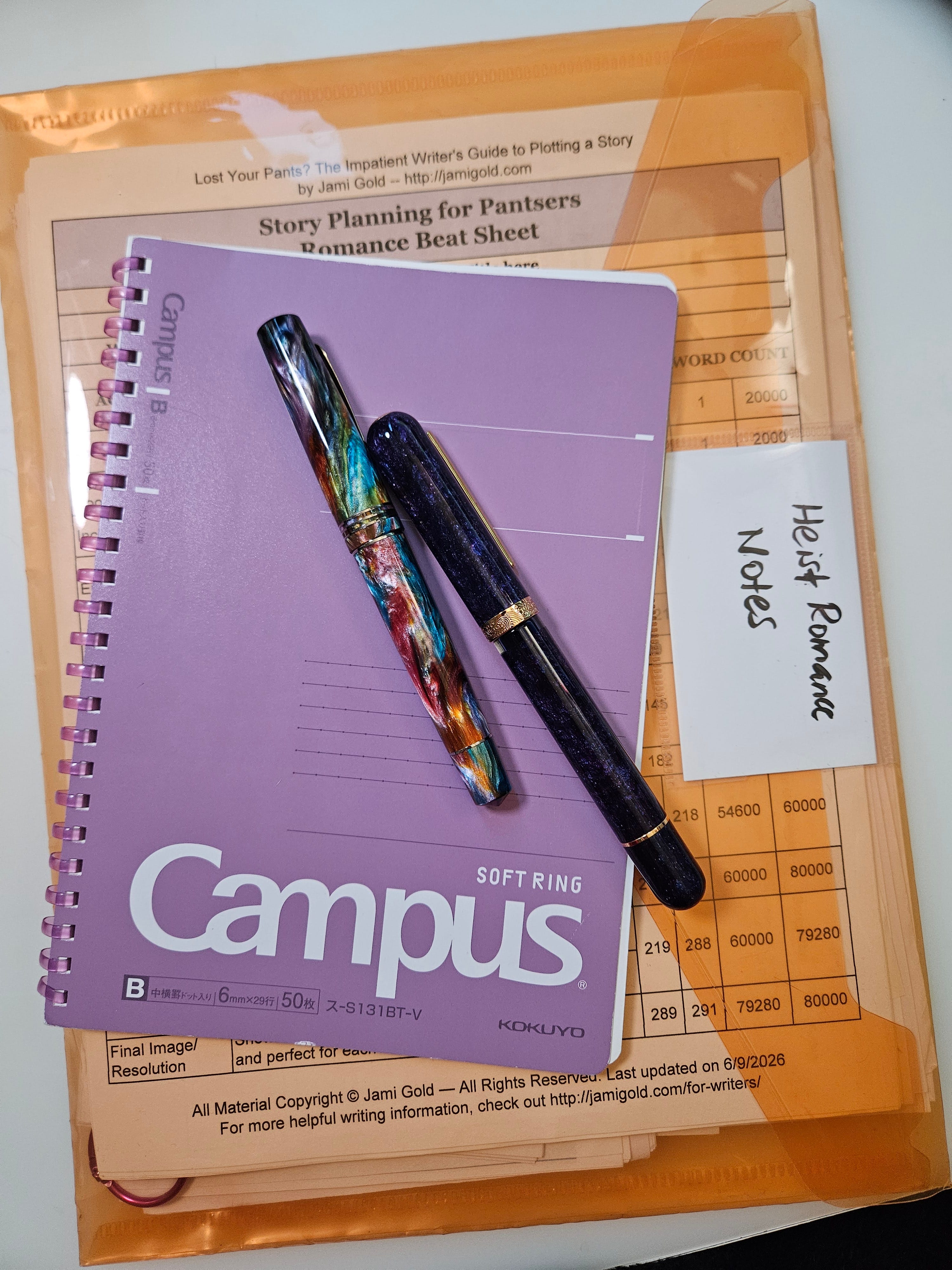
Then I remembered something: I love drafting by hand with my beloved fountain pen and paper. It activates my flow after one page. I’ve written about this two years ago, but why do I keep forgetting?
Somehow I’ve internalize that drafting my book means sitting at my computer and typing. It’s more efficient. I’m saving time by not having to transcribe my handwritten words into a document.
Who told me writing needed to be efficient?! Ah yes, the productivity industrial complex.
Why inefficiency is better for me
After completing and publishing three novels, you’d think I would already know my process. Yet I seem to fight it harder when I have a deadline, whether it’s due to my contract or self-imposed like my current work-in-progress.
Here’s my current zero/first draft process:
Research, character work, worldbuilding
Loosely outline the beats
Determine what needs to happen by the end of a chapter, scene, or beat.
Handwrite, which is usually barebones dialogue. Sometimes I don’t even have dialogue tags. Add brackets/notes on where to include interiority, sensual details, etc.
Take a break (usually a day)
Type up what I’ve written, filling in the gaps (and dialogue tags) as they come to me. If something takes too much time to figure out such as the choreography of a make-out session, I add brackets for later. I focus on the emotional parts.
Take a break and repeat steps 3-6.
Is this efficient? No.
Is it productive? Mostly yes.
Am I doing the work twice? Absolutely!
But in the time between drafting by hand and transcribing it into NovelPad, my subconscious brain has done its magic to fill in some of those blank spots. When I type up those pages, I’m adding more words so my characters and their world feel more alive, more three dimensional.
Now what?
At my current rate, I won’t finish my first draft by the end of August. I’m ok with that. I’m not going to push my body over its limit in order to meet my arbitrary goal.
I still have my body doubling dates with Lyssa. Knowing that I’ve promised to meet her twice a week to write means I will get some writing done.
My agent didn’t ask me to complete the entire novel. She knows I’m not a fast writer. This was my decision.
I’ve learned more about myself and what works for me as a writer. Each time I veer into what I’m supposed to do, I’m reminded to trust my process. I’m not trying to just finish a book.
I’m trying enjoy my creative process. What’s the point in writing if it doesn’t bring me joy?
Do you consider yourself an efficient or inefficient writer?
Such a fun and useful essay! I am also an inefficient writer, for a lot of the same reasons (hello, unpredictable body). Yet every time I start a new book, I decide to deviate from my process and aim for a new routine that just isn't me. I'm at the beginning of a new project right now, so this piece has hopefully saved me from that mistake in advance!
I LOVE handwriting first and then typing it up! It gives me two chances to really absorb what I just wrote—which allows me to tap more deeply into the characters and story for the next session.